The Benefits of Journaling: What Science Says About Why You Should Write
Decades of peer-reviewed research confirm that journaling improves mental health, sharpens thinking, strengthens your immune system, and accelerates personal growth. Here is everything you need to know.
Why Journaling Matters More Than Ever
In a world that moves at breakneck speed, most of us rarely pause to ask the simplest question: what am I actually feeling right now? We scroll, swipe, and refresh our way through the day, leaving thoughts and emotions unprocessed. Journaling is the antidote. It is a deliberate act of slowing down, turning inward, and giving your inner life the attention it deserves.
The benefits of journaling are not anecdotal folklore passed down by self-help gurus. Decades of peer-reviewed research confirm that putting thoughts into words—whether on paper or on a screen—produces measurable improvements in mental health, physical well-being, cognitive performance, and personal growth. This page walks through the evidence so you can decide for yourself whether journaling deserves a place in your daily routine.
Whether you have never written a journal entry or you have filled dozens of notebooks, the science applies to everyone. And with modern tools like WOYM, getting started has never been easier.
Mental Health Benefits of Journaling
The strongest body of evidence for journaling sits squarely in the mental health domain. Researchers have studied expressive writing for over four decades, and the results are remarkably consistent: writing about your thoughts and feelings reduces psychological distress and improves emotional well-being.
Stress Reduction
A landmark study by James Pennebaker at the University of Texas demonstrated that participants who wrote about stressful events for just 15 to 20 minutes a day over four consecutive days showed significant reductions in perceived stress. When you externalize a worry by writing it down, you transfer it from the endless loop of rumination into a concrete, visible form, reducing the cognitive load your brain carries throughout the day.
Cortisol, the body’s primary stress hormone, has been measured in several journaling studies. Regular journalers show lower cortisol levels compared to non-journaling control groups, suggesting that the stress reduction is not just perceived but physiological. WOYM’s built-in mood tracking lets you tag each entry with your emotional state, helping you spot stress patterns and identify triggers over weeks and months.
Anxiety Management
Anxiety thrives on uncertainty and vague dread. Journaling combats both. A 2018 study in Psychotherapy Research found that participants with generalized anxiety disorder who engaged in online expressive writing showed significantly fewer anxiety symptoms after one month compared to a control group.
The amygdala, our threat-detection center, fires rapidly when it perceives danger—even imagined danger. Writing about an anxious thought recruits the prefrontal cortex, the rational, language-oriented part of the brain, naturally dampening amygdala activity through a process neuroscientists call “affect labeling.” In practical terms, writing “I am anxious about the presentation on Friday because I am afraid of being judged” is far more calming than letting the thought swirl wordlessly.
“Writing about emotional upheavals in our lives can improve physical and mental health.” — James W. Pennebaker, PhD
Emotional Processing and Regulation
Life delivers a steady stream of emotional experiences—joy, frustration, grief, excitement, disappointment. Without a processing mechanism, these emotions pile up and manifest as irritability, numbness, or burnout. Journaling acts as a release valve. A meta-analysis of 146 expressive writing studies in Psychological Bulletin concluded that writing about emotional topics produces reliable improvements in psychological health, including reduced depressive symptoms and greater emotional clarity, across age groups, genders, and cultural backgrounds.
One especially valuable technique is to write about a difficult experience from multiple perspectives. If you had a conflict with a colleague, first write your own perspective, then try to articulate theirs. This builds empathy and strengthens your capacity for emotional regulation in real time, not just on the page.
Depression Support
While journaling is not a substitute for professional treatment, research shows it can be a valuable complement. A study in the British Journal of Health Psychology found that participants who wrote about positive experiences for three consecutive days reported improved mood and fewer visits to health centers in the following months.
For those experiencing depressive episodes, even writing a few sentences about something that went well during the day can interrupt the negative thought spiral that depression feeds on. Gratitude journaling has been specifically studied in this context, with results showing measurable mood improvements after just two weeks of daily practice.
Track Your Mood and Journal Daily
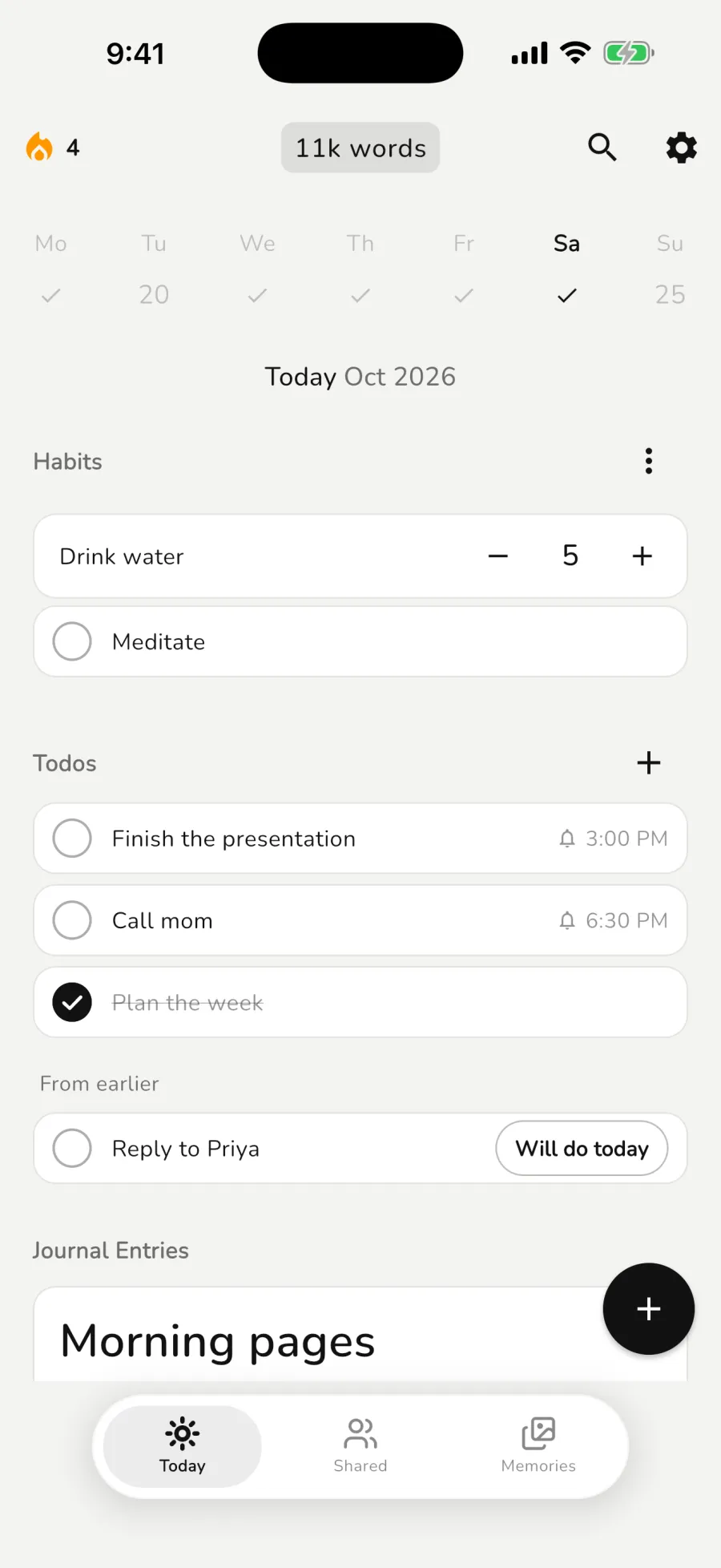
WOYM makes journaling effortless with mood tracking, goal setting, and a clean writing space. Start free today.
Cognitive Benefits: Sharper Thinking Through Writing
Journaling does not just make you feel better; it makes you think better. The act of translating abstract thoughts into structured language engages cognitive processes that improve memory, clarity, and problem-solving ability.
Improved Memory and Retention
Writing something down dramatically increases the likelihood that you will remember it. This is known as the “generation effect” in cognitive psychology. When you journal about your day, you consolidate short-term memories into long-term storage. A study at the University of Waterloo confirmed that writing engages motor memory pathways that strengthen recall, and even digital journaling outperforms simply thinking about events because choosing words forces deeper cognitive engagement.
Over months and years, your journal becomes a searchable record of your life. With WOYM, you can scroll back through entries and rediscover insights, ideas, and experiences you would have otherwise forgotten entirely.
Mental Clarity and Decision-Making
Have you ever felt overwhelmed by a decision, only to find clarity after talking it through with a friend? Journaling provides the same benefit without needing another person. Writing forces you to organize scattered thoughts into a linear narrative, which often reveals the answer you were looking for. By writing out pros and cons, your values, and your fears, you externalize the decision-making process. Research from the University of Chicago shows that expressive writing before a high-stakes decision frees up working memory for problem-solving.
Enhanced Problem-Solving
Journaling engages both analytical and creative thinking. Describing a problem in writing forces you to define it clearly, which is often the hardest and most important step. Stream-of-consciousness journaling, where you write freely without editing, is particularly effective for breaking through mental blocks. The technique bypasses your internal critic and allows unexpected connections to surface. Many scientists, engineers, and entrepreneurs keep journals for precisely this reason—not for sentiment, but for strategic thinking.
Physical Health Benefits
Perhaps the most surprising finding in journaling research is its impact on physical health. The mind-body connection is real, and journaling is one of the clearest demonstrations of how psychological well-being translates into physiological outcomes.
Immune System Function
Pennebaker’s original studies in the 1980s produced an unexpected result: participants who wrote about traumatic experiences not only felt better emotionally but showed improved immune function, with blood tests revealing increased T-lymphocyte activity. Subsequent research published in Psychosomatic Medicine found that expressive writing led to faster wound healing in older adults—participants healed a small skin biopsy wound an average of 11 days sooner than those who wrote about neutral topics, likely due to reduced cortisol levels and improved immune regulation.
Better Sleep
If you have ever lain awake with racing thoughts, journaling before bed can help. A 2018 study in the Journal of Experimental Psychology found that participants who wrote a to-do list for the next day fell asleep significantly faster than those who wrote about completed tasks. Beyond to-do lists, reflective evening journaling closes the mental loops left open during the day, giving your brain permission to shift into rest mode.
Pain Management
Chronic pain patients who journal report lower pain intensity and reduced reliance on medication. A study in the Annals of Behavioral Medicine found that expressive writing helped arthritis patients reduce disease severity scores by 28 percent after four months, likely through stress reduction and improved emotional regulation.
Personal Growth and Self-Awareness
Beyond the clinical benefits, journaling is one of the most effective tools for personal development. It creates a feedback loop between your actions and your reflections, allowing you to learn from experience rather than simply having experiences.
Deepening Self-Awareness
Self-awareness is the foundation of emotional intelligence, and journaling is arguably the most direct path to developing it. When you regularly write about your thoughts, feelings, and behaviors, patterns emerge that are invisible in the moment but obvious on the page. You might discover you always feel drained after certain meetings, that you are happiest on days when you exercise in the morning, or that a particular relationship consistently triggers insecurity. WOYM’s mood tracking and journaling features give you a visual timeline of your emotional landscape, making these patterns even easier to identify.
Goal Achievement
A study by Dr. Gail Matthews at Dominican University found that people who wrote down their goals were 42 percent more likely to achieve them. Journaling takes this further by providing a space to record goals, track progress, reflect on obstacles, and celebrate wins. Write down your goals at the start of the week, then review them in your journal. Ask: What progress did I make? What got in the way? What will I do differently? This iterative loop is the engine of continuous improvement. WOYM includes a dedicated goals feature that lets you set intentions alongside your journal entries.
Building Resilience
Journaling builds resilience by creating a written record of challenges you have overcome. On difficult days, you can look back and see tangible evidence that you have survived hard things before. Research from the University of Arizona found that divorced adults who wrote about their experience through narrative journaling showed greater emotional recovery than those who simply vented. The key was meaning-making: crafting a narrative that acknowledged pain while recognizing lessons learned.
Creative Benefits of Journaling
Almost every celebrated creative mind kept a journal. Leonardo da Vinci filled thousands of notebook pages with sketches, ideas, and observations. Virginia Woolf credited her diary with keeping her writing muscles limber. Frida Kahlo’s journal, filled with paintings and words, became a work of art in itself.
This is not coincidence. Journaling cultivates the two conditions creativity requires most: a habit of observation and a willingness to explore ideas without judgment.
Unlocking Creative Flow
Julia Cameron’s “Morning Pages” technique—writing three pages of stream-of-consciousness text first thing in the morning—has become a cornerstone practice for creatives worldwide. The technique works by silencing the inner critic early in the day. Once you have dumped your anxieties, to-do lists, and random musings onto the page, your mind is freer to engage in creative work.
Research supports this approach. A study published in Creativity Research Journal found that participants who engaged in free writing exercises before a creative task generated more original ideas than those who did not. The act of writing loosens cognitive rigidity, allowing the brain to make novel associations.
Capturing Ideas and Inspiration
Ideas are fleeting. The insight that strikes you during a morning walk will likely vanish by lunchtime if you do not record it. A journal serves as a reliable external memory for your creative life, a place to capture fragments, half-formed thoughts, and flashes of inspiration that can be developed later.
With WOYM’s media support, you can attach photos, sketches, and other visual content directly to your journal entries, making it a true multimedia creative notebook. This is especially valuable for visual thinkers and artists who think in images as much as words.
Developing Your Voice
If you want to become a better writer, write more. It sounds simplistic, but it is true. Journaling provides a low-stakes environment to experiment with language, try new styles, and develop your authentic voice. Unlike social media posts or work emails, journal entries have no audience. This freedom from judgment is precisely what allows your natural voice to emerge.
Ready to Experience These Benefits?
Join thousands of people who have made journaling a daily habit with WOYM. Free forever, no credit card required.
Relationship Benefits
Journaling is often thought of as a solitary practice, but its benefits extend directly into your relationships with others. By improving your emotional intelligence, communication skills, and self-understanding, journaling makes you a better partner, friend, parent, and colleague.
Improved Communication
When you regularly practice articulating your feelings in writing, you become better at articulating them in conversation. Journaling builds your emotional vocabulary, the specific, nuanced words needed to express what you are experiencing. Instead of saying “I’m fine” when you are not, you learn to say “I am feeling overwhelmed and need some quiet time,” which is infinitely more useful for the people who care about you.
Processing Conflict
After an argument, emotions run high and rational thinking takes a back seat. Writing about a conflict before attempting to resolve it gives you time to process the raw emotion and identify what you actually need. You might realize the argument was not about the dishes at all but about feeling unappreciated. That insight transforms the subsequent conversation from a blame session into a productive dialogue.
Gratitude and Appreciation
Gratitude journaling—writing down things you appreciate each day—has been shown to strengthen relationships. A study from the University of North Carolina found that individuals who expressed gratitude toward their partner reported feeling more positive about the relationship and more comfortable expressing concerns. When you actively notice and record the good things people do, you naturally become more appreciative and less critical.
Types of Journaling and Their Specific Benefits
There is no single “right” way to journal. Different approaches serve different purposes, and the best choice depends on what you are trying to achieve. Here is a guide to the most researched and practiced journaling methods.
Expressive Writing
The approach used in most clinical research. You write about your deepest thoughts and feelings regarding a significant experience. Best for emotional processing, stress reduction, and trauma recovery. Typically done in sessions of 15 to 20 minutes.
Gratitude Journaling
Write three to five things you are grateful for each day. Research by Robert Emmons at UC Davis shows this practice increases happiness, reduces depression, and improves sleep quality. It takes as little as five minutes and is an excellent starting point for new journalers.
Bullet Journaling
A structured system combining rapid logging, to-do lists, and reflections. Excellent for organization-minded people who want to combine productivity and self-reflection in a single practice. The structure appeals to those who find blank-page journaling intimidating.
Stream-of-Consciousness Journaling
Write whatever comes to mind without stopping, editing, or censoring. This technique is powerful for creative breakthroughs, processing complex emotions, and overcoming writer’s block. Julia Cameron’s Morning Pages are the most famous example.
Reflective Journaling
Review your day, week, or a specific experience with the goal of extracting lessons and insights. Common prompts include: What went well? What would I do differently? What did I learn? This is the style most commonly used in professional development and education.
Digital Journaling
Modern online journaling tools like WOYM bring advantages that paper cannot match: instant search, mood analytics, media attachments, cloud backup, and access from any device. Research suggests that the benefits of journaling are consistent regardless of medium, so choose whatever format reduces friction and increases the likelihood that you will actually write.
The Science Behind Journaling: How It Works in the Brain
Understanding why journaling works helps explain why its benefits are so broad. Several neurological and psychological mechanisms are at play.
Affect Labeling
When you name an emotion in writing, you activate the right ventrolateral prefrontal cortex, which reduces activity in the amygdala. Functional MRI studies by Matthew Lieberman at UCLA demonstrated this effect clearly: putting feelings into words—whether spoken or written—reduces the intensity of the emotional experience. This is why journaling about anger or sadness makes those feelings more manageable.
Cognitive Defusion
A concept from Acceptance and Commitment Therapy (ACT), cognitive defusion is the process of creating distance between yourself and your thoughts. Writing “I notice that I am having the thought that I am not good enough” is fundamentally different from believing “I am not good enough.” Journaling naturally creates this separation by externalizing thoughts onto the page, where they can be observed rather than blindly accepted.
Narrative Construction
Humans are meaning-making creatures. We understand our lives through stories, and journaling is the act of constructing those stories. Research shows that people who can create a coherent narrative about a difficult experience recover faster than those who cannot. The act of writing imposes structure on chaotic events, transforming raw experience into understandable narrative.
Working Memory Offloading
Your working memory has limited capacity. Unresolved worries, undone tasks, and unprocessed emotions all consume space in this finite system. Journaling offloads these items onto an external medium, freeing up cognitive resources for the task at hand. This is why people often report feeling “lighter” or “clearer” after journaling.
Getting Started: Making Journaling a Habit
Knowing the benefits of journaling is one thing. Actually doing it consistently is another. Here are evidence-based strategies for building a lasting journaling habit.
- Start small. You do not need to write for an hour. Five minutes is enough to capture meaningful thoughts. Research shows that even brief journaling sessions produce benefits when done consistently.
- Anchor it to an existing habit. Write right after your morning coffee or just before bed. Behavioral science shows that habit stacking—attaching a new behavior to an established one—dramatically increases adherence.
- Remove friction. Use a tool that is always accessible. WOYM’s online journal is available on your phone and browser, so you can journal whenever the urge strikes.
- Do not aim for perfection. Your journal is for you, not for an audience. Misspellings, incomplete sentences, and scattered thoughts are all perfectly fine. The goal is expression, not literary polish.
- Use prompts when stuck. Questions like “What am I feeling right now?” or “What is one thing I am grateful for today?” can break through blank-page paralysis.
- Review periodically. Set a monthly reminder to read back through recent entries. This review process deepens the benefits by reinforcing self-awareness and highlighting patterns you might have missed.
For a more detailed walkthrough, see our guide on how to start a journal.